Launched in 2019, the open-access London Stage Database (LSDB) includes details about more than 52,000 theatrical performances recorded and advertised in England’s capitol between 1660 and 1800. The site is not only a reference resource, but also a media archeological experiment—a recovery of a digital project that became obsolete almost as soon as it was completed in 1978. The problems of precarity, sustainability, and collective memory work haunting the implementation of this project have always had their mirror image in its content, which illustrates the practices of revival, adaptation, and embodied repertoire that sustained British performance culture across a period of near-constant rupture and crisis. These themes have taken on a new urgency in recent weeks, however, as the Trump administration has gutted the federal research funding enterprise and waged war on our institutions of higher education. On April 4, my team’s NEH grant for “Extending the London Stage Database” was abruptly terminated, disrupting our plans to grow the dataset, develop new content and features, and shore up our technical infrastructure over the next two and a half years. Against these daunting headwinds, this talk will look to the eighteenth-century stage for insights that might help us defend, maintain, and build community around sites of shared intellectual and cultural production.
Handouts
Seminar attendees: If you’d like to follow along on your own device, here’s a copy of the slides, plus a more printer-friendly list of quotations and references.
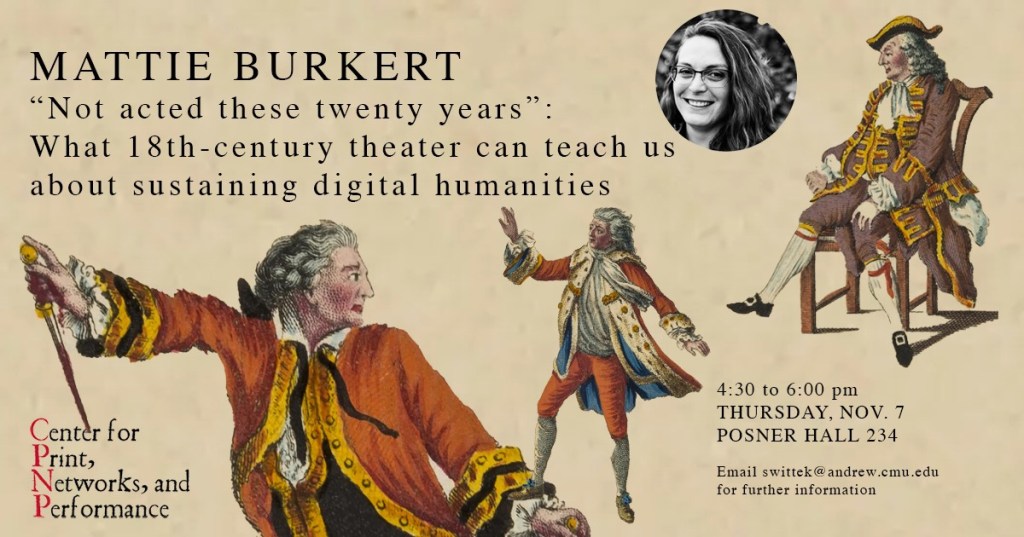
I’m giving a talk today at Carnegie Mellon’s Center for Print, Networks, and Performance — and it will be streamed on Zoom, for anyone who’s interested! I have to admit, it feels a bit strange to be giving a talk about early modern studies in a week when the immediate political and civic context feels so urgent. Still, these texts and histories give us so many ways of thinking about how those who came before negotiated the possibilities available to them, how they exercised agency within constraints, how they realized their commitments and reckoned with their complicities. And so — the show must go on; it can’t go on; it goes on.
Details
The talk will take place today, Thursday, November 7th, from 4:30 to 6:00 p.m. (Eastern Standard Time).
Abstract (click to expand)
Launched in 2019, the open-access London Stage Database includes details about more than 52,000 theatrical performances recorded and advertised between 1660 and 1800. It is also a media archeological experiment—a recovery of a digital project that became obsolete almost as soon as it was completed in 1978. With a new Digital Humanities Advancement Grant from the NEH, our team is extending the dataset and enhancing interoperability with Linked Open Data; developing new content and features to meet the emerging needs of users; and upgrading the technical infrastructure to (hopefully) avoid the fate of our predecessor. Along the way, we aim to preserve and extend the procedural rhetoric of the existing user interface, which foregrounds the layers of translation and remediation through which history becomes addressable as data, as well as the ease with which information is lost in the process. Of course, maintaining any space of collective cultural production—whether that be a physical playhouse, a theatrical repertoire, or a digital humanities project—requires constant, often invisible work by a network of individuals who care enough about the underlying material to continually transform it as times and technologies change. My talk envisions ways of performing this insight, through user experiences that emphasize not only the technical, but also the social dimensions of sustainability and preservation.
Zoom info (click to expand)
Time: Nov 7, 2024 04:30 PM Eastern Time (US and Canada) | Meeting ID: 978 1418 5197 | Passcode: 858762
My co-chair and I are still accepting proposals for our ASECS 2023 session on “Performance and Digital Technologies” through the extended deadline of October 24! Check out the session description below; you can submit an abstract using this form.
#77. Performance and Digital Technologies
Co-Chairs:
Mattie Burkert, University of Oregon
Cassidy Holahan, University of Pennsylvania
Description:
The COVID-19 pandemic has highlighted the relationships between performativity and digital culture. As classrooms and professional gatherings moved online, we experienced first-hand the tensions and possibilities that emerge when our scholarly performances are mediated by digital technologies. This panel solicits papers on the methodological, theoretical, and pedagogical interanimations of DH and theater studies, which remain relatively siloed in our period of study. What insights might these fields offer one another, given their shared interests in embodiment, interaction, temporality, mediation, and public formation? Possible topics include:
The performativity of remote and hybrid teaching, including remediation of in-person teaching materials, construction of instructor presence, and ways to foster connection within learning management systems, Zoom rooms, and annotation platforms;
The scholarly publics created by virtual conferences and town halls, including the operations of power, inclusion, and solidarity in these spaces;
The uses of social media platforms (e.g. Twitter, TikTok) and forms (e.g. memes) to perform scholarly and teacherly identities;
The affordances and limitations of digital technologies to adapt long-eighteenth-century drama for twenty-first century audiences;
The promise and challenges of DH methods for theater studies, especially the disjunction between the embodied repertoire of the stage and the typically text-centric ways of classifying humanities data;
And the archives, traces, and forms of repeatability left by these ephemeral performances.
We warmly encourage submissions from current and prospective members of the DH and TaPS Caucuses, graduate students, early-career scholars, contingently or precariously employed and independent researchers, and members of underrepresented and oppressed communities.
In our 2016 essay, “Archives, Numbers, Meaning: The Eighteenth-Century Playbill at Scale,” we presented a quantitative analysis of over 1,400 archival playbills from mid-eighteenth-century London (you can download our data here). Our analysis showed that in this period, the seemingly empty designation “a Play” functioned as a marker of mixed and sometimes indeterminate genre. As an example, we examined playbills for the numerous theatrical adaptations of Aphra Behn’s Oroonoko that proliferated in this period:
Over the course of the eighteenth century this novella was adapted to the London and Edinburgh stages at least six times, advertised variously as a tragedy, a tragicomedy, and “a Play.” This case study reveals that eighteenth-century theatrical publics had an idiom, previously unrecognized by scholars, for talking about generic ambiguity and even using it to market performances. Oroonoko and other plays that similarly challenged conventional generic and authorial categorization were often advertised as “a Play,” a seemingly empty label that is revealed to carry significance when these playbills are subjected to quantitative analysis. (599)
Last month, I conducted further archival research at the British Library (thanks to the generous support of the Center for Women and Gender at Utah State University) that has borne out some of the claims that we made in that article.
One of the items I saw at the BL is a scrapbook of theatrical materials collected by Sir Augustus Henry Glossop Harris (1852-1896), an actor and dramatist who, in the 1870s, took on the project of bringing back the abandoned Drury Lane theater — earning him the nickname “Druriolanus” (Oxford Dictionary of National Biography). In his short life, Harris collected 45 volumes of playbills and six volumes of newspaper clippings, donating the latter collection to the British Library in 1888.
Scrapbooking was a common practice, not only among theater professionals like Harris but among theatergoers and enthusiasts; as Sharon Marcus notes, the practice of clipping theatrical advertisements, news items, and reviews had its roots in early modern commonplacing and was popular over the eighteenth and nineteenth centuries (287). Many scrapbookers preserved ephemera from their own playgoing, but in this case Harris also attempted to compile a history of the London theaters a century earlier, primarily through cuttings of newspaper advertisements for performances.
Newspapers began carrying theater advertisements regularly in the first decade of the eighteenth century. Early notices were minimal and directed readers to the “great bills” (broadside playbills posted around town) for additional information; gradually the newspaper ads became more detailed, recording cast lists, entr’acte entertainments, benefit announcements, and other selling features of a given performance.
Volume 6 of Harris’s collection of clippings (dated October 1719 to August 1736 on the binding) includes 21 separate ads for Oroonoko performances between 1719 and 1723. The examples below are taken from Harris’ scrapbook; Harris must have clipped them from the Daily Post or the Daily Courant, the two papers that carried such advertisements during the 1719-20 theatrical season (The London Stage, 1660-1800, Part 2, Volume 2, page 547). As the juxtaposition of these two ads suggests, the phrase “a Play” occupies the same space in the advertisement for Oroonoko that the phrase “a Comedy” occupies in that for The Amorous Widow.
Reproduced with permission from British Library General Reference Collection Th.Cts.6.Without exception, the 21 advertisements tout performances of “a Play, call’d, OROONOKO,” language that mirrors that which we found in playbills from later decades. These advertisements expand the archive of our earlier study to documents beyond playbills and broaden the time period to the earlier part of the eighteenth century. They demonstrate that the practice of using “a Play” as generic appellation in theater publicity (and notably, in advertisements for Oroonoko) dates back decades before the earliest items in our playbills dataset.
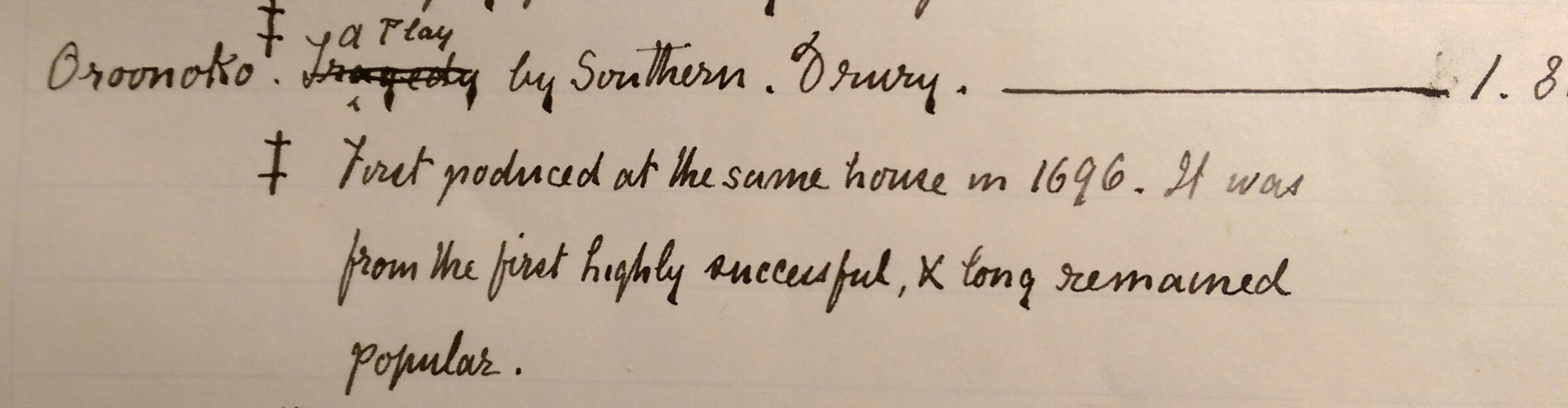
Before the pages of advertisements, the scrapbook begins with a detailed index of play titles labeled “1719-20”, which includes the following entry for Oroonoko:
Reproduced with permission from British Library General Reference Collection Th.Cts.6.
Oroonoko‡. Tragedy ^A Play by Southern. Drury.
‡ First produced at the same house in 1696. It was from the first highly successful, + long remained popular.
Not once do Harris’s newspaper sources designate Oroonoko a tragedy, yet he has written “Tragedy,” crossed it out, and inserted the superscript words “A Play” — reaffirming our conviction that “a Play” serves as a designation of genre previously unrecognized as such by theater scholars.
Furthermore, this entry and its revision suggests how the term “a Play” was mobilized and re-mobilized in British theatrical culture as a generic marker. Harris signals the accreted history of the adaptation and re-adaptation of Behn’s novella first as a tragic play with a comic subplot and later as a straight tragedy. Harris’ move to strike out “Tragedy” reverses the typical temporality of the palimpsest. Though “Tragedy” — a later generic designation — is visible beneath the strike-through, it is “a Play” — the designation from earlier adaptation — that emerges from its erasure to sustain the resonance of Oroonoko’s complicated generic life on stage.
Taken together, these advertisements establish the broader practice of using “a Play” as generic appellation in newspaper ads (which go hand in hand with playbills) going back to the beginning of the eighteenth century, while Harris’ emended index points to the continued resonance of the appellation well into the nineteenth century. These archival findings, then, affirm our previous conclusions based on our quantitative analysis and suggest how computational and archival work may be brought together in an iterative process.
![Alt Text: [1720] Not Acted this Season, For the Benefit of Mr. Pack. By the Company of Comedians, At the Theatre in Little Lincoln’s-Inn-Fields, this present Tuesday, being the 6th Day of December, will be presented a Comedy, call’d The Amorous Widow; or, The Wanton Wife. The part of Barnaby Brittle to be perform’d by Mr. Pac. With Entertainments of Dancing by Mons. Dupre, Mr. Newhouse, Mr. Cook, Mr. Sandham and his Son, Mrs. Hutton, Mrs. Bullock, and Miss Francis. [1720] By the Company of Comedians, At the Theatre in Little Lincoln’s-Inn-Fields, to Morrow being Wednesday, the 7th Day of December, will be presented a Play, call’d OROONOKO. The Part of Oroonoko by Mr. Ryan. With several Entertainments of Musick to be performe’d by Two Germans lately arriv’d, who imitate the French Horn and Trumpet with their Natural Voices, in all their different Parts: And also several other Entertainments of Vocal Musick.](https://mattieburkert.com/wp-content/uploads/2017/09/image-for-blog-post.png)